
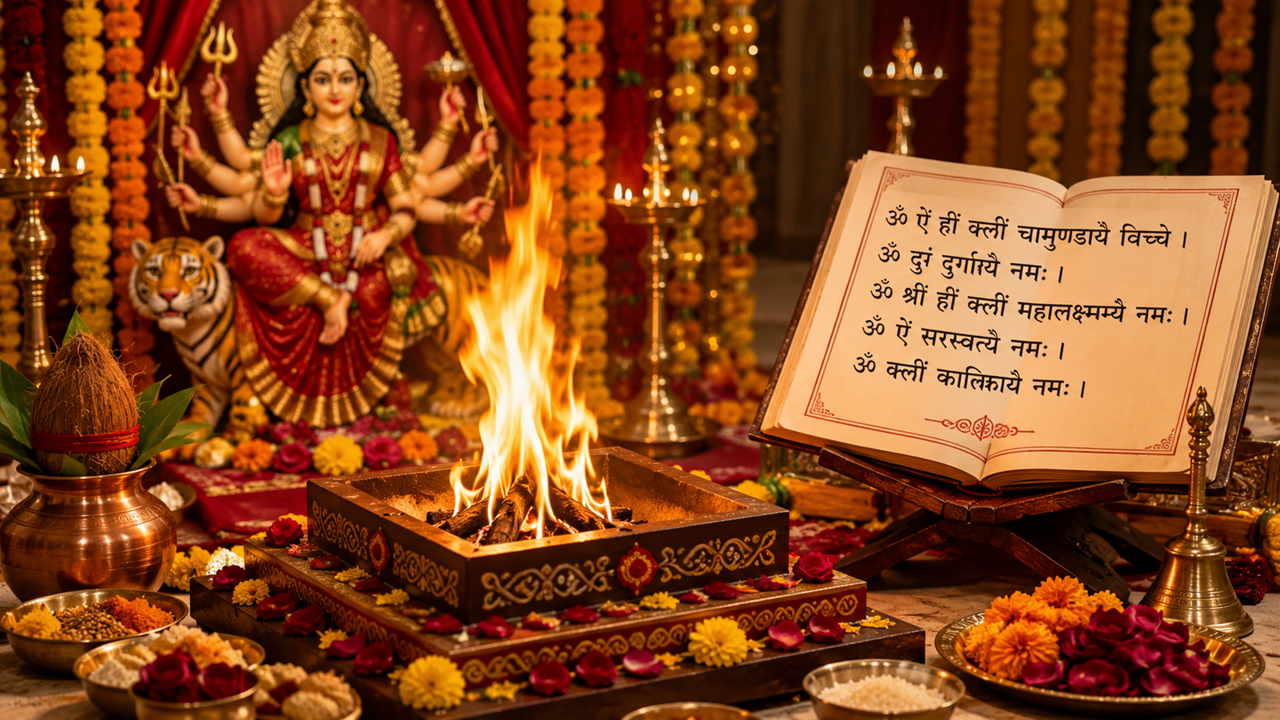
Navratri Havan Mantra: Complete List of Powerful Mantras for Havan
Navratri is one of the most loved festivals in India. It is celebrated with a lot of joy, devotion, and energy. People fast, dance, decorate their homes, and pray to Goddess Durga and her nine forms for nine days. Among all the rituals of Navratri, the Havan (also called Homam or fire ritual) holds a very special place. It is usually done on the eighth day (Ashtami) or the ninth day (Navami), and it marks the completion of the nine-day worship.
If you are planning to do a Havan at home this Navratri, or if you simply want to understand the mantras used during this sacred fire ceremony, this guide will help you. We will explain everything in very simple words, so that even if you are doing this for the first time, you will feel confident and ready.
A Quick Introduction to Navratri
Before we talk about the Havan and its mantras, let us take a moment to understand Navratri itself. The word "Navratri" comes from two Sanskrit words, "Nav" meaning nine, and "Ratri" meaning nights. So Navratri literally means nine nights. During these nine nights and days, Goddess Durga is worshipped in her nine different forms, each representing a different quality such as strength, wisdom, courage, purity, and compassion.
Navratri is celebrated four times a year in the Hindu calendar, but the most popular and widely celebrated one is Sharad Navratri, which usually falls in September or October. This is the one most people think of when they talk about Navratri, and it is followed by Dussehra, which celebrates the victory of good over evil.
During these nine days, many people observe fasting, visit temples, decorate their homes with flowers and lights, and perform daily puja. In many parts of India, especially in Gujarat, this time is also marked by Garba and Dandiya dance nights. In Bengal, it is celebrated as Durga Puja with huge decorated pandals. Despite the different styles of celebration across regions, the devotion to Goddess Durga remains the common thread everywhere.
The Havan on the eighth or ninth day is seen as the spiritual peak of this celebration. It is the moment where all the prayers, fasting, and devotion of the previous days come together in one powerful ritual.
What Is Havan and Why Is Fire Considered So Important
To understand why Havan is such an important part of Navratri, it helps to understand the role of fire in Hindu tradition. Fire, or Agni, is considered one of the most sacred elements. It is seen not just as a physical element but as a living force that carries our prayers to the gods.
In ancient times, long before temples with idols became common, fire rituals were the main way people worshipped and connected with the divine. Every offering made into the fire, whether it was grain, ghee, or herbs, was seen as a gift being carried upward through the smoke to the gods. This tradition has continued for thousands of years and is still followed today during festivals, weddings, housewarming ceremonies, and many other important occasions.
During Navratri, the Havan becomes a way to formally thank the Goddess for her presence and blessings during the nine days. It is also seen as a way of purifying the home, the family, and even the chanting that has been done throughout the festival. Many people believe that any errors made during the daily puja, whether in pronunciation, timing, or ritual, are corrected and forgiven through the Havan.
What Is Navratri Havan and Why Is It Done
Havan is a fire ceremony where we offer things like ghee, grains, herbs, and wood to a sacred fire while chanting mantras. The fire is seen as a messenger between us and the gods. When we offer something into the fire, it is believed that the offering reaches the divine directly through the flames and smoke.
During Navratri, the Havan is done to thank Goddess Durga for her blessings during the nine days of worship. It is also done to ask for forgiveness if any mistake happened during the puja, to purify the home and the atmosphere, and to invite peace, health, and prosperity into the family.
Many people believe that a Havan done with the right mantras and a pure heart can remove negative energy from the house. It also brings a feeling of calmness and positivity. The smoke from the Havan, especially when herbs like camphor, sandalwood, and other natural items are used, has a cleansing effect on the air too.
When Should You Do the Navratri Havan
Most families do the Havan on Ashtami (the eighth day) or Navami (the ninth day) of Navratri. Some people also do it on both days if they wish. The timing usually depends on family traditions and what a priest or elder in the family suggests. It is considered auspicious to do the Havan in the morning, but many people also do it in the evening depending on their convenience.
Before starting the Havan, it is important to have a clean space, a clean mind, and all the required items ready. Many families invite a priest to guide them, especially if they are not familiar with the process. But if you know the basic mantras and steps, you can also do a simple Havan at home with your family.
Things You Need for Havan
Before we go into the mantras, let’s quickly look at the items you will need for the Havan. This will help you prepare everything in advance so the ceremony goes smoothly.
You will need a Havan kund, which is a small square or round pit made of copper, brass, or clay, used to hold the fire. You will also need mango wood or any other sacred wood, ghee (clarified butter), camphor, dry coconut, sesame seeds, rice, barley, and a mixture called Havan samagri, which is easily available in stores during Navratri season. Other important items include a matchbox or lighter, a spoon for pouring ghee, red cloth, flowers, kumkum, turmeric, and a picture or idol of Goddess Durga placed near the Havan kund.
Once everything is ready, you can begin the Havan with a simple prayer, followed by the mantras.
Starting the Havan – Ganpati Vandana
Every Hindu ritual traditionally begins with a prayer to Lord Ganesha. He is worshipped first because he is known as the remover of obstacles. Chanting his name before starting anything important is believed to make the task successful and free from problems.
The common mantra chanted at the beginning is:
"Om Gan Ganpataye Namah"
This simple mantra is chanted a few times while offering a small amount of ghee or rice into the fire. This step is important because it sets a positive and obstacle-free beginning for the entire Havan.
Invoking Goddess Durga
After the Ganpati prayer, the next step is to invoke Goddess Durga into the Havan. This is done so that her energy and blessings are present throughout the ceremony.
A commonly used mantra for this is:
"Om Dum Durgayei Namah"
This mantra is chanted while offering small amounts of Havan samagri or ghee into the fire. It calls upon the Goddess to bless the ceremony and be present with the family performing the ritual.
The Navadurga Mantras – Mantras for the Nine Forms of Durga
The most important part of the Navratri Havan is chanting mantras for each of the nine forms of Goddess Durga, known as Navadurga. Each day of Navratri is dedicated to one form of the Goddess, and during the Havan, mantras for all nine forms are usually chanted together, especially if the Havan is done only once, on Ashtami or Navami.
Below are the nine forms and their mantras, explained simply.
Shailaputri is the first form, known as the daughter of the mountains. She represents strength and purity. Her mantra is:
"Om Hreem Shailaputryei Namah"
Brahmacharini is the second form, symbolizing devotion and penance. Her mantra is:
"Om Hreem Brahmacharinyei Namah"
Chandraghanta is the third form, known for her courage and grace. Her mantra is:
"Om Hreem Chandraghantayei Namah"
Kushmanda is the fourth form, believed to be the creator of the universe with her smile. Her mantra is:
"Om Hreem Kushmandayei Namah"
Skandamata is the fifth form, the mother of Lord Skanda (Kartikeya). Her mantra is:
"Om Hreem Skandamatayei Namah"
Katyayani is the sixth form, known for her fierce and protective nature. Her mantra is:
"Om Hreem Katyayanyei Namah"
Kalaratri is the seventh form, representing the destroyer of darkness and evil. Her mantra is:
"Om Hreem Kalaratryei Namah"
Mahagauri is the eighth form, symbolizing peace and purity. Her mantra is:
"Om Hreem Mahagauryei Namah"
Siddhidatri is the ninth and final form, the giver of spiritual powers and success. Her mantra is:
"Om Hreem Siddhidatryei Namah"
While chanting each mantra, a small offering of ghee, rice, or Havan samagri is made into the fire. Many families chant each mantra either once, nine times, or 108 times, depending on their tradition and the time they have available.
The Powerful Durga Gayatri Mantra
Along with the Navadurga mantras, many people also chant the Durga Gayatri Mantra during the Havan. This mantra is considered very powerful and is believed to bring protection, strength, and wisdom.
The mantra is:
"Om Kaatyayanaay Vidmahe, Kanya Kumaari Dhimahi, Tanno Durgih Prachodayat"
This mantra is usually chanted multiple times, often 11 or 21 times, while offering ghee into the fire. It is believed to awaken inner strength and courage in the person chanting it.
The Durga Beej Mantra
Another important mantra used during Havan is the Durga Beej Mantra. A "beej" mantra means a seed mantra, which is short but very powerful in its sound and vibration.
The mantra is:
"Om Dum Durgayei Namah"
Although this looks similar to the invocation mantra mentioned earlier, it is repeated many times during the Havan, often 108 times using a mala (prayer beads), to deeply connect with the energy of the Goddess.
Mantra for Protection – Durga Kavach
Many families also include parts of the Durga Kavach during their Havan or before starting it. Durga Kavach means the armor of Durga, and it is chanted for protection from negative energies, fear, and danger.
While the full Durga Kavach is quite long, a simple and commonly used line from it is:
"Om Sarva Mangala Mangalye Shive Sarvartha Sadhike, Sharanye Trayambake Gauri Narayani Namostute"
This shloka is very popular and is often chanted not just during Havan but also during daily prayers. It means that the Goddess is the one who brings auspiciousness to everything, and the devotee bows to her completely.
Mantra for Removing Obstacles and Negative Energy
Since Havan is also done to remove negativity from the home and life, many people chant this protective mantra as well:
"Om Aim Hreem Kleem Chamundaye Vichche"
This is known as the Navarna Mantra, and it is considered extremely powerful in Durga worship. It combines the energies of Mahakali, Mahalakshmi, and Mahasaraswati, the three main forms of the Goddess. This mantra is usually chanted before the main Havan begins, and sometimes throughout the ceremony as well.
Understanding the Meaning Behind Each Navadurga Mantra
It can be helpful to understand what these mantras actually mean, rather than just memorizing the sounds. This makes the chanting more meaningful and helps you feel a deeper connection during the Havan.
Shailaputri means "daughter of the mountain," and she is often shown riding a bull, holding a trident and a lotus. Chanting her mantra is believed to bring stability and grounded strength, much like a mountain that does not move no matter how strong the storm.
Brahmacharini represents devotion, discipline, and the power of penance. Her name means one who practices austerity. Chanting her mantra is believed to help a person develop patience and inner focus, especially useful for anyone going through a difficult or challenging phase in life.
Chandraghanta gets her name from the half-moon shaped like a bell that she wears on her forehead. She represents bravery and grace combined together. Her mantra is often chanted by people seeking courage to face a difficult situation while still remaining calm and graceful.
Kushmanda is believed to have created the universe with just her smile, and her name is connected to the word for a cosmic egg. She represents creative energy and the source of all life. Devotees chant her mantra when they seek new beginnings, creativity, or a boost of positive energy in their life.
Skandamata is the mother of Lord Kartikeya (also called Skanda), the god of war. She represents motherly love, protection, and nourishment. Her mantra is especially meaningful for parents, or anyone seeking the caring and protective energy of a mother figure.
Katyayani is known as a fierce warrior form of the Goddess, born to sage Katyayana. She represents strength used for justice and protection. Her mantra is often chanted by those seeking courage against injustice or difficulty, and it is also associated with removing obstacles in marriage and relationships.
Kalaratri, despite her fearsome appearance, is actually seen as the most protective and compassionate form of the Goddess. Her name means "the night of darkness," and she represents the destruction of ignorance, fear, and negativity. Her mantra is chanted by those who want to overcome deep fears or negative influences in their life.
Mahagauri represents purity, peace, and calmness after the storm. Her name means "extremely white" or "fair," symbolizing purity of the soul. Her mantra is chanted for peace of mind, forgiveness, and emotional healing.
Siddhidatri, the final form, is the giver of spiritual powers and perfection. Her name means "the one who grants siddhis," or spiritual accomplishments. Her mantra is often chanted at the end of the Navadurga chanting, as a way of asking for completeness, success, and fulfillment of one's efforts.
Understanding these meanings can help you connect more personally with each mantra, rather than simply repeating the words. Many devotees choose to focus a little longer on the form of the Goddess that relates most closely to what they are going through in their own life at that time.
The Connection Between Havan and Kanya Pujan
In many households, the Havan is closely connected with another important ritual called Kanya Pujan, which involves worshipping young girls as living forms of the Goddess. This is usually done on Ashtami or Navami, either just before or just after the Havan.
During Kanya Pujan, young girls, usually below the age of ten, are invited home. Their feet are washed, they are offered new clothes or gifts, and they are served a special meal, often including foods like puri, halwa, and chana. This ritual is based on the belief that young girls represent the pure and untouched energy of the Goddess herself.
While Kanya Pujan and Havan are two separate rituals, many families choose to perform them together as part of the same celebration, since both are meant to honor the divine feminine energy of Durga. If you are planning your Navratri celebration, it can be a beautiful idea to include both rituals, first performing the Havan with mantras, and then honoring young girls with Kanya Pujan afterward.
Regional Variations in Havan Mantras and Rituals
India is a large and diverse country, and the way Havan is performed can vary slightly depending on the region, family tradition, and the specific priest guiding the ceremony. In North India, the Navadurga mantras and the Durga Saptashati (a sacred text with 700 verses dedicated to the Goddess) are commonly used during the Havan.
In Bengal, the Havan performed during Durga Puja often includes mantras from a text called the Chandi Path, along with special mantras dedicated to the immersion of the Goddess idol at the end of the festival.
In South India, especially during Golu celebrations, the rituals may be slightly different, with more emphasis on displaying dolls and figurines, though the Havan and mantras dedicated to Durga remain fairly similar in spirit.
Despite these regional differences, the core idea remains the same everywhere: fire is used as a medium to connect with the divine, and mantras are chanted to invoke the blessings of Goddess Durga in her many forms. If your family follows a particular regional tradition, it is always best to follow the mantras and steps passed down through your own family, as these carry personal and cultural significance.
Offering Ahutis – The Method of Offering into the Fire
While chanting any of these mantras, small offerings called "ahuti" are made into the fire. Each ahuti usually ends with the word "Swaha", which means the offering is complete and accepted by the fire god, Agni.
For example, a full mantra with an ahuti would sound like this:
"Om Hreem Shailaputryei Namah Swaha"
The word "Swaha" is added at the end of most mantras during Havan, right before pouring the offering into the fire. This small word is very important, as it symbolically completes the offering.
Final Aarti and Closing the Havan
Once all the mantras are chanted and the offerings are made, the Havan is usually closed with an aarti dedicated to Goddess Durga. This is a joyful and musical way to end the ceremony, where family members sing songs praising the Goddess while a lit lamp (diya) is moved in circular motions in front of her idol or picture.
After the aarti, it is common to ask for forgiveness for any mistakes made during the puja or Havan. A simple line often used for this is:
"Om Kshamaya Namah"
This means "I bow and ask for forgiveness." It is a humble way of accepting that as humans, we may not have performed everything perfectly, and we seek the Goddess's understanding and blessings despite our shortcomings.
What Goes Into Havan Samagri and Why It Matters
The mixture of herbs and natural items burned during Havan, known as Havan samagri, is not chosen randomly. Each ingredient has a purpose, both spiritual and practical. Traditional Havan samagri usually includes dried herbs, sandalwood powder, camphor, cloves, dried rose petals, dried coconut pieces, and a few other natural aromatic substances.
From a spiritual point of view, each of these ingredients is believed to carry certain qualities. Sandalwood is associated with purity and calmness. Camphor is believed to represent the burning away of ego and impurities. Cloves and other spices add a grounding, warm energy to the ritual.
From a practical point of view, many of these ingredients also have natural antiseptic and air-purifying properties. When burned, they release aromatic smoke that can help freshen the air in the home, especially after the smoke settles and the space is aired out. This is one of the reasons many people say their home feels lighter and more peaceful after a Havan.
If you cannot find a pre-made Havan samagri packet, most local grocery stores or pooja item shops during Navratri season sell them at affordable prices. It is also common to find them online closer to the festival season. If you are unable to get the exact traditional mixture, a combination of simple rice, ghee, and a small amount of camphor can still be used respectfully for a basic home Havan.
Chanting the Mantras Together as a Family
One beautiful aspect of Navratri Havan is that it does not have to be a solitary or overly formal ritual. In many homes, the entire family sits together around the Havan kund, and mantras are chanted together, sometimes led by the eldest member of the family or by whoever is most comfortable with the pronunciation.
This shared chanting creates a sense of unity and togetherness. Even young children, who may not fully understand the meaning of the Sanskrit words, often enjoy the rhythm and sound of the chanting, and over the years, they naturally learn the mantras simply by listening and repeating them during family gatherings.
If your family includes members who speak different languages or who are more comfortable with English, it can also be helpful to explain the meaning of each mantra in simple words before chanting it, just as we have done in this guide. This way, everyone in the family, regardless of their familiarity with Sanskrit, can feel connected to the deeper meaning behind the ritual, rather than just repeating unfamiliar sounds.
After the Havan – What to Do Next
Once the Havan is complete and the fire has been allowed to settle, there are a few small steps that many families follow. The ash from the Havan, known as "vibhuti" or "bhasma," is often collected once it has completely cooled down. This sacred ash is sometimes applied to the forehead as a blessing, or kept in a small container and used for future prayers.
It is also common practice to distribute prasad, which is the food that has been offered to the Goddess during the puja and Havan, among family members and guests. This usually includes sweets like halwa, or other simple dishes made especially for the occasion.
Many families also choose this time to break their Navratri fast, especially if they have been observing a strict fast for the nine days. The meal after Kanya Pujan and Havan is often simple but special, prepared with love and shared together as a family.
Finally, once everything is complete, it is common to thank the Goddess one last time with a simple prayer of gratitude, acknowledging the blessings received during the nine days of Navratri, and asking for her continued presence and protection in the days ahead.
Simple Tips for Doing Havan at Home
If this is your first time doing a Havan, here are a few simple tips that can help make the process smoother and more meaningful.
Try to keep the space clean and calm before starting. It helps to light a diya and some incense sticks before the Havan begins, to create a peaceful atmosphere. If you are not confident about your Sanskrit pronunciation, don't worry too much. What matters most is your devotion and intention. Many priests say that even simple mantras, chanted with a sincere heart, are just as powerful as long and complicated ones.
It also helps to involve the whole family in the Havan. Children can help with small tasks like handing over items or repeating simple mantras. This makes the ritual more joyful and helps pass on the tradition to the next generation.
Lastly, always make sure to have water nearby in case you need to put out the fire safely after the Havan is complete. Safety should always come first, especially if you have young children or pets at home.
Benefits of Doing Navratri Havan
People who perform Havan regularly during Navratri often talk about the peace and positivity they feel in their homes afterward. Some of the commonly believed benefits include purification of the environment, removal of negative energy, better health due to the medicinal herbs burned in the fire, and a feeling of spiritual connection with the divine.
Many also believe that doing Havan with the family strengthens relationships, as everyone comes together with a shared purpose and devotion. It is not just a religious ritual but also a moment of unity and gratitude within the family.
A Simple Step-by-Step Summary
To make things even easier, here is a short summary of the steps involved in a basic Navratri Havan.
First, prepare the Havan kund and gather all the required items. Second, light the fire using wood and a small amount of camphor. Third, begin with the Ganpati mantra to remove obstacles. Fourth, chant the Navarna mantra for protection and purification. Fifth, invoke Goddess Durga with her main mantra. Sixth, chant the mantras for all nine forms of Durga, one by one, while offering ahutis into the fire. Seventh, chant the Durga Gayatri mantra and any other mantras your family traditionally follows. Eighth, close the Havan with the forgiveness mantra and a final aarti.
This simple structure can be followed by any family, whether you have a priest guiding you or you are doing it yourself with the help of a mantra book or online guide.
Common Mistakes to Avoid During Havan
Even though Havan is a beautiful and welcoming ritual, there are a few common mistakes that beginners often make. Knowing about these in advance can help your ceremony go more smoothly.
One common mistake is not preparing all the items beforehand. It can be very disruptive to pause in the middle of chanting mantras to search for camphor or matches. It is always better to keep every item within arm's reach before you light the fire.
Another mistake is rushing through the mantras without any pause or focus. While it is fine to chant at a comfortable pace, rushing through the words just to finish quickly takes away from the purpose of the ritual, which is focused devotion. It is better to chant slowly and clearly, even if it means the Havan takes a little longer.
Some people also forget to keep water nearby for safety. Since an open fire is involved, it is important to always have a bucket of water or a fire extinguisher nearby, especially if you are performing the Havan indoors or in a space with children and pets around.
Lastly, many beginners feel nervous about correct Sanskrit pronunciation and end up skipping the mantras altogether. This is not necessary. Priests and elders often say that devotion matters far more than perfect pronunciation. It is perfectly fine to chant the mantras as best as you can, with sincerity and respect.
Can You Do Havan Without a Priest
A common question many people have is whether it is acceptable to perform Havan without a priest. The answer is yes, many families do perform simple Havans at home on their own, especially if they have grown up watching their parents and grandparents do it.
If you are new to this and feel unsure, it can help to write down the mantras on a piece of paper or keep this guide open in front of you while performing the Havan. You do not need to memorize everything perfectly. What matters most is your intention and the respect you bring to the ritual.
That said, if you want a more elaborate or traditional Havan, especially for special occasions, inviting a priest can add a sense of structure and authenticity, as they are trained in the correct order of mantras and rituals. Ultimately, the choice depends on your comfort level and family tradition.
Frequently Asked Questions About Navratri Havan
Is it necessary to fast before doing Havan? Many people who observe Navratri fasting continue their fast until the Havan and Kanya Pujan are completed, after which they break their fast with a special meal. However, fasting is a personal choice and not a strict requirement for performing the Havan itself.
Can Havan be done at any time of the day? While mornings are generally considered auspicious, many families also perform Havan in the evening based on convenience. What matters most is doing it with focus and devotion, rather than sticking to a very rigid time.
How many times should each mantra be chanted? This can vary based on family tradition. Some chant each mantra once, some chant nine times to represent the nine days, and others use a mala to chant 108 times for deeper devotion. Any of these approaches is considered acceptable.
What if I make a mistake while chanting? It is completely normal to make small mistakes, especially if you are not fluent in Sanskrit. The forgiveness mantra chanted at the end of the Havan is meant exactly for this purpose, to ask the Goddess to overlook any unintentional errors.
Can Havan be performed in an apartment or a small space? Yes, many people today use small, portable Havan kunds that are safe to use even in apartments. Just make sure there is proper ventilation, and always keep water nearby for safety.
Final Thoughts
Navratri Havan is a beautiful way to end the nine days of devotion to Goddess Durga. It brings together fire, mantras, and heartfelt prayers to create a powerful and peaceful atmosphere in the home. While the mantras may seem long or difficult at first, with a little practice, they become familiar and meaningful.
What truly matters during this ritual is not perfection, but sincerity. Whether you are an experienced devotee or someone doing this for the very first time, approaching the Havan with respect, patience, and an open heart will make the ceremony special and blessed.