
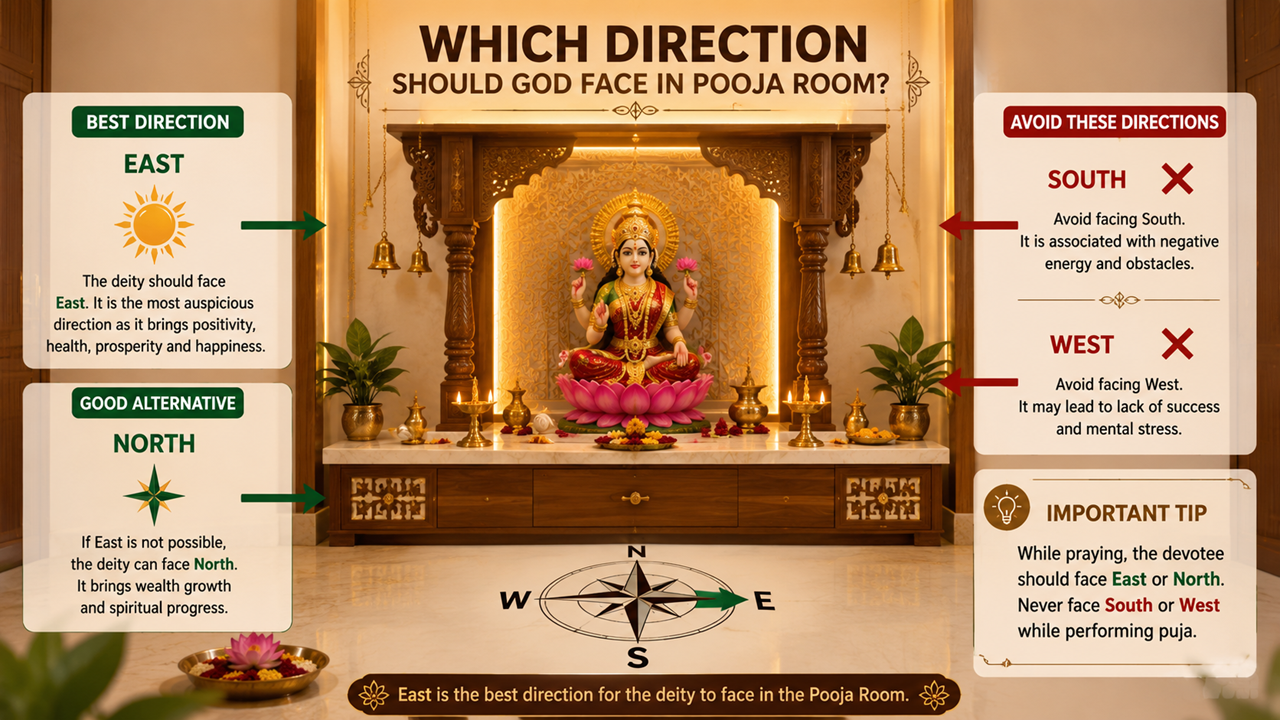
which direction should god face in pooja room
If you are building a new home, renovating your house, or simply setting up a small prayer corner, one question comes to almost every Hindu family's mind. That question is: which direction should God face in the pooja room? This small detail feels big because our elders always talk about "Vastu" and "correct direction" when it comes to placing the temple at home. Many people get confused, worried, or even scared that if they place the idols in the wrong direction, something bad may happen. But do not worry. In this blog, we will explain everything about pooja room direction in very easy and simple words, so that even a person who has never heard about Vastu Shastra before can understand it fully.
We will talk about the right direction for the pooja room itself, the direction the idols or photos of God should face, the direction you should face while praying, and many small but useful tips that will help you set up a peaceful and positive prayer space at home. So let us start from the very beginning.
Why Direction Matters for a Pooja Room
Before we jump into directions, let's understand why direction is even important. In Hindu tradition, and especially in Vastu Shastra, it is believed that every direction carries a different kind of energy. Some directions are considered auspicious, full of positive energy, while others are believed to bring restlessness or negative energy if not used properly.
Vastu Shastra is an old Indian science of architecture. It talks about how a building, a room, or even furniture should be placed so that natural energies like sunlight, air, and magnetic forces work in favor of the people living there. The pooja room is considered the most sacred part of the house because this is where the family connects with God, prays for peace, and seeks blessings. So it is natural that people want this space to have the most positive energy possible.
Many people also connect this practice with our ancestors' way of living close to nature. In old times, homes were built keeping in mind the direction of sunrise, sunset, wind flow, and temperature. The pooja room direction rules are also based on these natural signs, especially the rising sun, which is seen as a symbol of new beginnings, purity, and positivity.
The Best Direction for a Pooja Room
According to most Vastu experts, the northeast direction of the house is considered the best place for a pooja room. In Vastu language, this direction is called "Ishaan Kon" or the Ishaan corner. It is believed that this corner is ruled by the water element and is naturally full of divine energy. The northeast direction receives the first rays of the morning sun, and because of this, the energy here is considered fresh, pure, and calm.
If it is not possible to have the pooja room in the northeast corner of the house, then the next best options are the east direction or the west direction. Both these directions are considered good for placing a temple at home. The east direction is linked with the sunrise and is seen as extremely positive. The west direction, though slightly less preferred than east, is still considered acceptable by most Vastu followers.
The south direction is generally not recommended for a pooja room. This is because south is considered to be ruled by Yama, the god of death, according to some beliefs, and this direction is thought to bring heavy or restrictive energy. However, many modern Vastu consultants say that a small pooja shelf can be adjusted in the south if there is no other space available, as long as certain corrections are made, like keeping the area clean, well-lit, and using mirrors or specific colors to balance the energy.
It's important to remember that in many small homes, apartments, or flats, people don't always get the choice of picking their pooja room's direction because the house is already built. In such cases, do not stress too much. You can still follow the idol facing direction rules, which we will explain next, and that alone can bring a lot of positivity to your prayer space.
Which Direction Should the Idol or God's Photo Face
This is the most common question people ask, and it is slightly different from the direction of the room itself. The direction of the room is about where the pooja room is located in the house. But the direction the idol faces is about which way the statue or picture of God is looking.
According to most Vastu experts, the idols or photographs of God should face the east or the west direction. This means if you are placing the murti or picture inside a mandir or temple unit, its face should point towards east or west.
Why east or west? Because when the idol faces east, the person praying will naturally face west, or when the idol faces west, the person praying will face east. Wait, that might sound confusing, so let's simplify it even more.
Actually, there is an interesting rule that many people don't know. It is often said that while praying, the person should ideally face east or north direction, because these directions are considered spiritually powerful and calming. Now, if the person praying faces east, that means the idol placed in front of them would be facing west. And if the person praying faces north, the idol would be facing south, but since south is not preferred, the general suggestion becomes: keep idols facing east or west, so that the devotee praying in front of them naturally ends up facing west or east too, and ideally ends up facing east or north while sitting for prayers.
To put it simply, in most homes, people place their pooja units against the west wall so that when they stand or sit for prayer, they are facing east, and the idols placed inside are automatically facing west, looking towards the person.
Alternatively, some homes place the pooja unit against the south wall so the person praying faces north, which is also considered a good direction for prayer.
So here is the easy way to remember it:
- If you want to face east while praying, place your temple unit on the west wall of the room.
- If you want to face north while praying, place your temple unit on the south wall of the room.
Both of these setups are considered good according to Vastu.
Why East and North Are Preferred for Praying
You may wonder why east and north are given so much importance. Let's understand this in a simple way.
East is the direction where the sun rises. Sunrise is a symbol of new hope, energy, positivity, and a fresh start. Almost every culture around the world gives special importance to the rising sun. In Hindu tradition, the sun is also worshipped as Surya Dev, one of the most important deities. So facing east while praying is like welcoming this fresh, positive energy into your life every single day.
North is considered important because of the earth's magnetic field. It is said that the magnetic pull of the north direction has a calming effect on the human mind and body. Many yoga and meditation practices also recommend facing north or east while sitting for meditation because it is believed to help in maintaining focus, peace, and balance.
Because of these reasons, both east and north are seen as spiritually and scientifically supportive directions for prayer, meditation, and worship.
What About South Direction
We already mentioned that south is generally avoided for pooja rooms. But many people still have some space constraints in their homes, and the only wall available might be the south wall. So, what should you do in such a case?
If a pooja room absolutely must be placed in the south, some Vastu experts suggest a few remedies. You can place the idols in a way that they face north, so the worshipper faces south, which is not ideal, but some Vastu practitioners believe you can improve this by using specific colors like light yellow or cream in that area, keeping the space extremely clean, adding good lighting, and using a small mirror to reflect the energy back.
However, if you have a choice, always try to avoid south for the pooja room. Most families manage to find a north, east, or northeast spot somewhere in the house, even if it means keeping just a small shelf or a corner table for the deities.
Ground Floor Pooja Room Vastu
Another common question is about which floor the pooja room should be on if you live in a multi-story house. According to Vastu Shastra, the ground floor is considered the best place for the pooja room. It is believed that placing the temple on the ground floor keeps the energy grounded and stable, and it becomes easily accessible for all family members, including elders and children.
If your house does not have space on the ground floor and you are forced to have the pooja room upstairs, that is generally acceptable too. The main thing to avoid is placing the pooja room directly above or below a bathroom, staircase, or store room, because these are considered to carry heavy or unclean energy that could clash with the sacred purpose of the temple space.
Placement Tips Inside the Pooja Room
Now that we know the best direction for the room and for the idols, let's talk about a few more practical tips that can help make your prayer space more peaceful and positive.
First, always try to keep the pooja room clean and clutter-free. A messy or dusty temple space does not create a calm environment for prayer. Even a small clean corner feels more sacred than a large messy room.
Second, avoid placing the pooja room in the bedroom if possible. If you have no other choice and the pooja unit has to be in the bedroom, it is advised to keep it in a separate cupboard or curtain-covered space, away from the bed, and ideally not visible while sleeping.
Third, the idols should not be placed directly on the floor. Always use a raised platform, shelf, or proper temple unit so the deities are placed at a respectable height, generally around chest level or higher for the person standing in front.
Fourth, avoid keeping broken idols or torn pictures of God in the pooja room. If any idol gets damaged or a picture gets torn, it is traditionally recommended to immerse it in a river or respectfully dispose of it, rather than keeping it in your prayer space.
Fifth, do not place the idols facing each other directly. For example, two large idols should not stare directly into each other's faces because it is believed this may create tension in the energy of the space. Arrange them side by side instead.
Sixth, try to leave a small gap between the wall and the idols. This is not just a Vastu tip but also practical, as it allows air circulation and makes cleaning easier.
Seventh, an oil lamp or diya, if used, should ideally be placed in the southeast corner of the pooja room, since southeast is associated with the fire element in Vastu Shastra.
Eighth, avoid keeping the pooja room directly under a staircase, because the space under a staircase is often considered to have unstable and heavy energy, not suitable for worship.
Which Direction Should You Sit While Praying
We touched on this earlier, but let's go a little deeper. When you sit down to pray, meditate, or read religious scriptures, the recommended directions to face are east or north. Facing east connects you with the energy of the rising sun, which symbolizes positivity and fresh beginnings. Facing north connects you with the earth's natural magnetic energy, which is believed to bring calmness and mental clarity.
It is generally advised to avoid facing south while praying, as this direction is associated with lower or heavier energy in many traditional beliefs. Facing west is considered acceptable but not as powerful as east or north.
If your home setup naturally makes you face south while praying because of space limitations, do not panic. The intention, devotion, and peace you bring into your prayers matter the most. Vastu is meant to support and enhance your life, not create fear or stress.
Common Mistakes People Make With Pooja Room Direction
Let's go through some common mistakes that many people accidentally make when setting up their pooja room at home.
One mistake is placing the pooja room directly opposite the main entrance door. This is usually avoided because the pooja room is meant to be a peaceful and private space, and having it right at the entrance can make it feel exposed and less sacred.
Another mistake is keeping the pooja room next to or above the kitchen stove. Since fire and prayer energy do not always mix well according to Vastu, it's better to have some separation between the cooking stove and the temple area.
A very common mistake is placing the idols facing the main door directly. Instead, the idols should ideally face into the room, with the worshipper standing between the idol and the door, not the idol facing straight out the door.
People also often forget about lighting. A pooja room that is dark, dull, or poorly lit does not create the right atmosphere for worship. Good natural light or soft yellow lighting is usually recommended.
Some families also unintentionally store unrelated items like shoes, dirty laundry, or unused furniture in or near the pooja room. This clutter is considered disrespectful to the sacred space and can disturb the positive energy.
Vastu Tips for Small Apartments and Flats
Many people today live in small apartments where they cannot always follow every single Vastu rule perfectly, and that is completely okay. Here are some adjusted tips for smaller homes.
If you don't have space for a full pooja room, a small wall-mounted temple unit works just as well. Try to place it against a wall so that when you sit for prayer, you naturally face east or north.
If your apartment's northeast corner is occupied by a bathroom or kitchen, which happens often in modern flats, choose the next best available option, which is usually a corner in the living room or a hallway nook that gets good natural light.
You can also use foldable or small-sized temple furniture that can be tucked into a cupboard or a dedicated shelf when not in use, which is a smart solution for very small homes.
Balcony pooja spaces have also become popular in recent years, especially in apartments where indoor space is limited. If you choose this option, make sure the space is protected from direct rain or too much dust, and still try to keep the idols facing east or west.
Understanding the Spiritual Meaning Behind Direction
Beyond the physical rules of Vastu Shastra, there is also a spiritual meaning behind why certain directions are chosen for prayer. Facing east while praying is often connected with a sense of gratitude towards the new day and new opportunities. It's like a fresh page of a book, encouraging positive thoughts and a fresh mindset.
Facing north is often linked with stability, wisdom, and inner peace, since north has traditionally been seen as a fixed and reliable direction, similar to how a compass needle always points north.
The idea of keeping God's idols facing you, the worshipper, is symbolic too. It represents a two-way connection, like God watching over you and blessing you, while you offer your prayers, gratitude, and devotion in return.
How to Set Up Pooja Room Direction Step by Step
If you are setting up a pooja room fresh, here is a simple step by step guide you can follow.
Step one, identify the northeast corner of your house using a simple compass app on your phone or a physical compass.
Step two, if the northeast corner is available and not occupied by a bathroom, staircase, or store room, this is your best spot for the pooja room.
Step three, if northeast is not available, choose the east or north wall of any suitable room in your house.
Step four, place your temple unit or shelf against the wall so that the idols, when placed inside, face east or west.
Step five, make sure that when you stand or sit in front of the temple for prayer, you are facing either east or north.
Step six, keep the space clean, add proper lighting, and avoid clutter around the pooja unit.
Step seven, if you use a diya or oil lamp, place it towards the southeast corner of the pooja room space.
Step eight, avoid placing the pooja room directly above or below a bathroom, and avoid placing it right next to or under a staircase.
By following these simple steps, you can create a pooja room setup that aligns well with traditional Vastu recommendations.
Does Direction Really Matter, or Is Devotion More Important?
This is an important question that many modern families ask, especially younger generations who may be more practical and less traditional in their thinking. The honest answer is that different people have different beliefs on this topic.
Traditional Vastu followers believe that direction genuinely affects the energy flow in your home and can influence the peace, prosperity, and harmony of the family. They believe that following these rules carefully brings better results in prayers and overall well-being.
On the other hand, many spiritual teachers and religious leaders say that devotion, sincerity, and the purity of your heart matter far more than the exact direction you are facing. They believe that God is present everywhere, in every direction, and true prayer comes from genuine faith rather than perfect placement.
A balanced way to look at this is that following Vastu guidelines can help create a peaceful, organized, and positive physical environment at home, which naturally supports better focus during prayer and meditation. But even if you are not able to follow every single direction rule perfectly, your devotion and intention while praying still hold great importance.
So, if you can set up your pooja room following the northeast rule and east or north facing directions, that is wonderful. But if your home layout does not allow for this, do not feel guilty or worried. Simply pray with a calm mind and honest heart, and that itself carries great spiritual value.
Simple Do's and Don'ts for Pooja Room Direction
To make things even easier, here is a simple list of do's and don'ts that you can keep in mind.
Do's: Keep the pooja room in the northeast corner if possible. Place idols facing east or west. Sit facing east or north while praying. Keep the space clean and well-lit. Use light and soft colors like white, cream, or light yellow in the pooja room. Keep a small gap between the idols and the wall.
Don'ts: Do not place the pooja room in the south direction if avoidable. Do not keep the pooja room under a staircase. Do not place the pooja room directly above or below a bathroom. Do not keep broken idols or torn pictures in the temple space. Do not place the pooja unit directly facing the main entrance door. Do not store unrelated or dirty items in the pooja room.
Final Thoughts
Setting up a pooja room at home is a beautiful way to create a peaceful and sacred space within your living environment. While Vastu Shastra offers helpful guidelines about which direction is best for placing your pooja room and which way the idols should face, it is equally important to remember that faith, devotion, and a calm mind play a huge role in your spiritual practice.
If you can follow the northeast direction for your pooja room, along with placing idols facing east or west, and sitting to pray facing east or north, that is considered ideal according to traditional beliefs. But if your home does not allow for this perfect setup, do not stress too much. Focus on keeping your prayer space clean, peaceful, and filled with positive energy, and let your devotion do the rest.
At the end of the day, a pooja room is not just about following rules, it is about creating a small corner of peace, gratitude, and connection in your busy daily life. Whether your temple faces east, west, north, or even south due to space constraints, what truly matters is the love, respect, and sincerity you bring into that sacred space every single day.
We hope this guide has helped you understand everything about pooja room direction in a simple and clear way. Use these tips as a helpful starting point, adjust them according to your home's layout, and most importantly, create a prayer space that brings you peace, positivity, and a stronger connection with your faith.